Showing posts with label ballast. Show all posts
Showing posts with label ballast. Show all posts
Tuesday, October 28, 2014
Ballast and Starter Fluorescent Lamp
Installation of fluorescent lamp circuits, we can see that most of the foot fluorescent lamp mounted in series with the ballast and partly installed pareral the starter.
Ballast
Ballast

Ballast resistor is basically a coil (choke coil) is an iron core. Fluorescent lamp ballasts in the works:
- Provide the initial installation of the electrodes in order to provide free electrons in large numbers
- Provide a potential wave big enough to hold a spark between two electrodes
- Preventing the occurrence of an increased flow of sparks that exceeds a certain limit for each lamp size.
Starter
 Starter on a fluorescent lamp consists of a small glass balloon filled with noble gases. Inside the bubble there are two metal electrodes as dual filament. The distance between the two electrodes are arranged with a certain distance so that the starter will turn on voltage of 100-200 V. Starter switch serves as the delay time (time delay switch) are connected in parallel with two-foot fluorescent lamp.
When the fluorescent lamp is connected to the voltage of tissues, then in a short time starter filament is connected (on) and then decide again if the lamp has been lit with a stable NE. At the time of the filament is connected, a large current will flow through the ballast from the power grid, then to the lamp electrodes, wire electrodes and the other starter, for subsequent return to the network. The existence of these currents will make the incandescent lamp electrodes and removing electrons.
Meanwhile, the voltage at the starter has been lost, so that the starter went out and become cool. Both dual metal electrodes in the starter going straight back and decided that the current is flowing. Because of the sudden termination of this, the ballast will be raised an electromotive force is quite high. Shock voltage is in series with line voltage. When raised at the right time, the voltage at the two filament lamps TL will be high enough to ignite the filament-provided tube filaments are hot enough.
In the first cycle of the tube is not already on the events as described above will be repeated, until the tube lights up. After the fluorescent lamp is lit, the starter will be parallel with the lamp. Therefore, the voltage on the lamp voltage is lower than the starter, the starter will remain extinguished.
To reduce the spark at the spark electrode bi-metal can be mounted a small capacitor in parallel with the starter. Installation of condenser is also able to improve the termination of the current in the starter and reduce radio interference.

Wednesday, September 24, 2014
Simple FAN 7710 Ballast Control
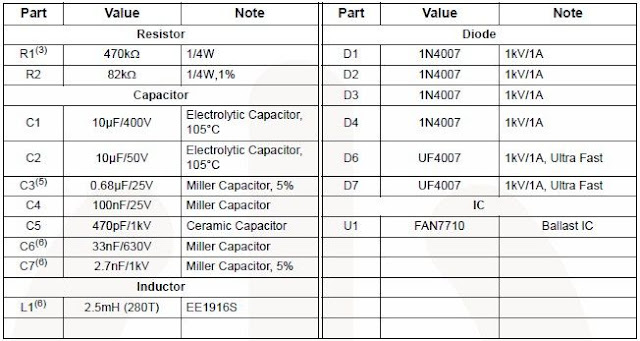
Using the FAN 7710 Ballast Control IC for Compact Fluorescent Lamps developed using Fairchild’s unique highvoltage process and system-in-package (SiP) concept can be designed a very simple low cost fluorescent lamp driver electronic project .The FAN7710 ballast control controls internal high-voltage stress and delivers 20W to the lamp at 320VDC voltage.
FAN7710 ballast control incorporates a preheating /ignition function, controlled by an user-selected external capacitor, to increase lamp life. The FAN7710 detects switch operation from after ignition-mode through an internal active Zero-Voltage Switching (ZVS) control circuit.

The AC line input voltage (230 VAC 50 Hz) is rectified to provide a bus voltage of approximately 320 volts DC. Startup resistor R1 supplies initial power to the FAN7710 IC.The IC begins to oscillate and the charge pump circuit consisting of C2, D2 and D7 supplies the current to the VDD pin, which gets regulated through the internal 15-V shunt regulator.
Subscribe to:
Posts (Atom)